Table of Contents
You ask a supplier what custom pouches would cost. The minimum on the quotation is 5,000 pieces. For a shop sending out 40 orders a month, that is 10 years of stock.
Packaging decisions get made twice, and most guides cover only one of them. You send out the pouch, the card and the outer bag with every order, so they are a running cost. You buy the bust, the tray and the stand once and keep them for years, so they are a fixture. Treating both as one presentation budget is how retailers end up with a stockroom full of branded pouches and a display that still looks temporary.
We have supplied jewelry, accessories and packaging to European retailers since 2002, and more than 150,000 customers have registered with us. This guide covers what a working packaging kit contains, what it costs you per order, and the three levels of branding open to a small shop. It also covers why display works differently, and what to settle with a supplier before you commit.
Jewelry Packaging for Small Business
Most packaging advice assumes one signature product and one look. A shop buying stock wholesale has a different job, because the assortment changes every season and the packaging has to work across all of it.
The per-order kit
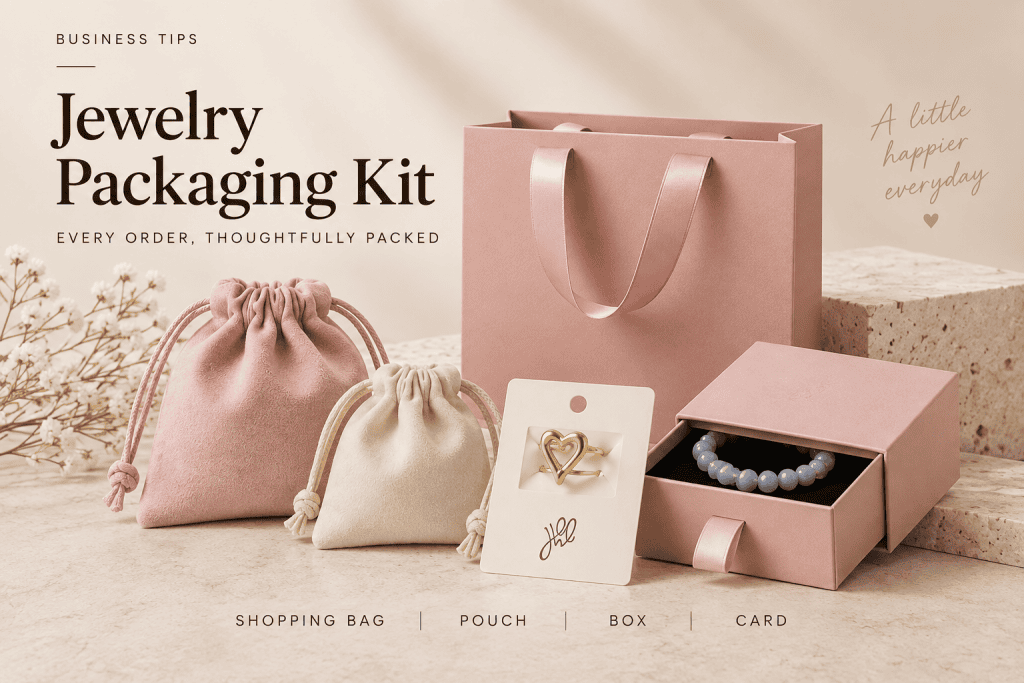
Three layers cover almost every order. You present the piece on a card, in a pouch or in a box, then pack that into an outer bag or a padded envelope.
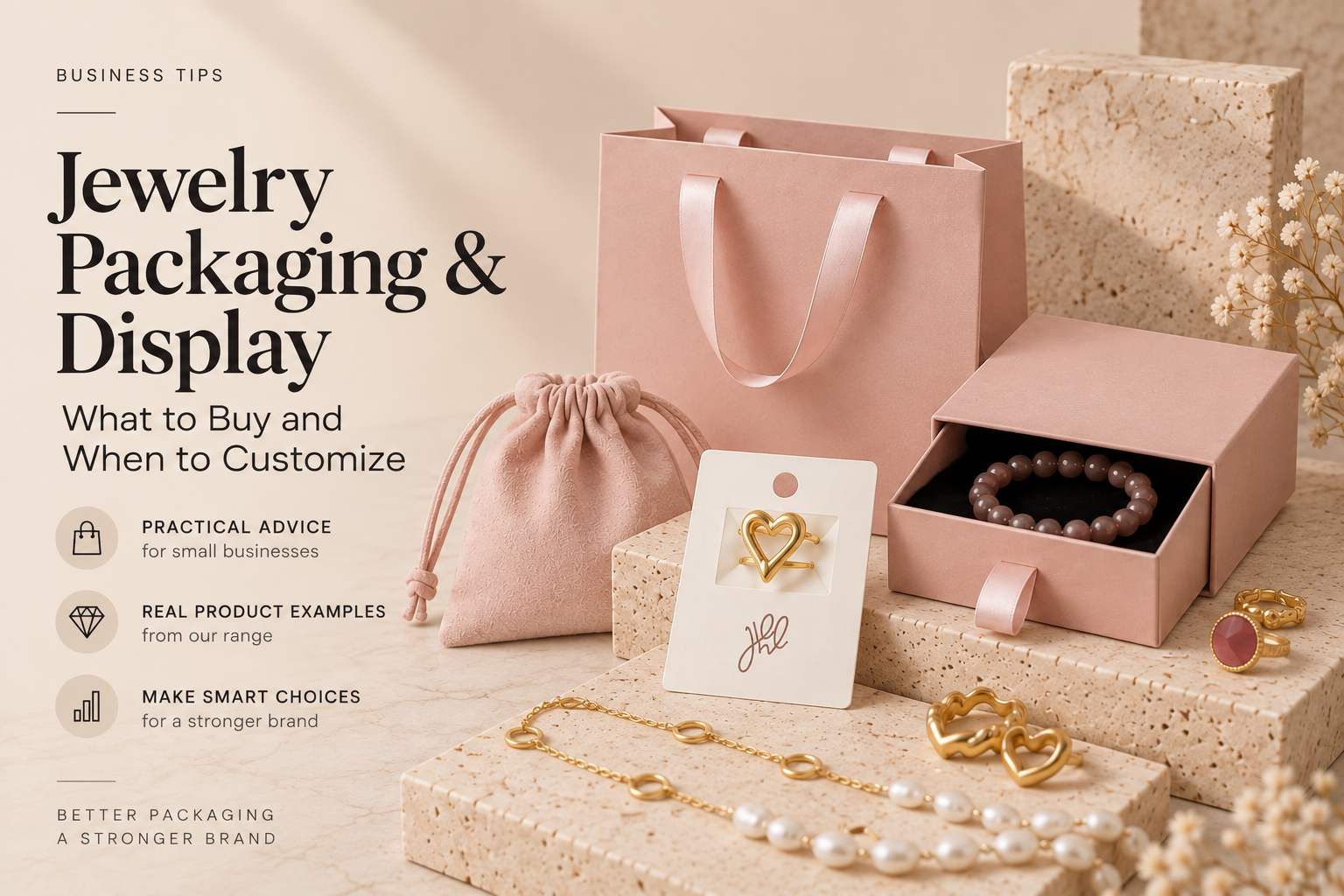
Pouches, boxes and shopping bags carry the volume, with packing paper, envelopes, cards and stickers behind them. Our own packaging and display range covers all of it.
Matching packaging to a mixed assortment
Buy to fit the widest item you stock rather than the average one. A pouch that takes a chunky bracelet will also take a pair of studs, while the reverse fails at the counter.
Work out how few formats your range needs, since each extra size means another line to reorder and another decision at the packing table.
What Packaging Costs You per Order
Packaging is quoted per piece, which makes it look cheap. What matters is what you send out with each order, and what you had to buy up front to get there.
Working out your cost per order
Take a branded set of three custom items. The figures below come from a current production quotation and are indicative only, since the real number depends on material, size, print method and quantity.
- A printed jewelry card, 6 x 5 cm, at 2,000 pieces: EUR 0.07
- A fabric pouch, 8 x 10 cm, at 5,000 pieces: EUR 0.20
- A paper shopping bag, 21 x 18 x 4 cm, at 2,000 pieces: EUR 0.53
That comes to roughly EUR 0.80 per order. Set it against an illustrative piece bought at EUR 3.50 and sold at EUR 10.50, and packaging takes about 11% of the gross margin on a single-item sale. Published fulfillment benchmarks put fully branded ecommerce packaging at USD 1.50 to USD 4.00 an order, so a card and a pouch keep you at the cheap end.
What the quoted quantity commits you to
Those prices are tiers, not minimums. Ordering less is usually possible at a higher price per piece, so the real question is what the cheap unit price costs you in cash. At 40 orders a month, 2,000 cards last 50 months. The 5,000 pouches last more than 10 years. Cash committed comes to EUR 140 for the cards, EUR 1,000 for the pouches and EUR 1,060 for the bags. That is EUR 2,200 tied up in a stockroom.
The EUR 2,200 splits unevenly. Cards are cheap enough per piece that the quantity barely matters. Moving from 2,000 to 5,000 of them costs about EUR 10 more in total, and drops the unit price from EUR 0.07 to EUR 0.03. Pouches and outer bags are where the money locks up, and those are the items to buy carefully.
The Three Levels of Branding
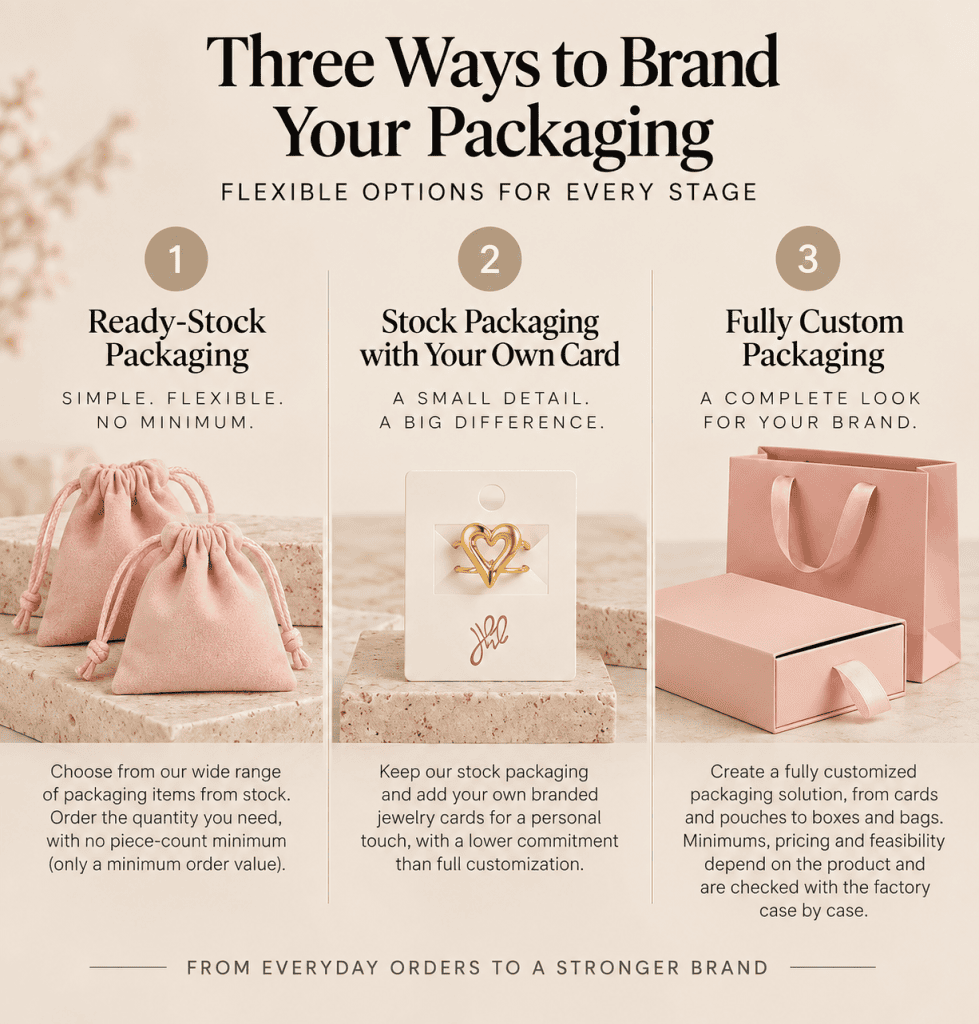
Branding your packaging is a ladder rather than a switch. Each step costs more and commits more, and plenty of shops never need the top one.
Level one, bulk jewelry boxes from stock
Buy packaging the way you buy product, from stock, in the quantity you need. Since the packaging is already made and waiting in a warehouse, there is no piece-count minimum to meet.
The practical floor is the supplier’s order value. Ours is EUR 30 after discounts, excluding shipping and tax, and packaging can be mixed into the same order as jewelry and accessories. This is also the sensible way to buy jewelry gift boxes wholesale, since demand for gift packaging arrives in seasonal bursts. Most of our current products carry no supplier branding, so stock packaging and stock product together already look like your own shop.
Level two, stock packaging with your own card
This is the cheapest way to put your name on an order. Keep the stock pouch or box, and add your own printed card, sticker or ribbon. A card is the smallest item in the kit, and the customer sees the piece against it.
You get a branded unboxing without a production run behind it, which is where to stay while you are still learning what sells.
Level three, custom jewelry boxes wholesale
Once volume becomes predictable, custom production is worth the commitment. Logo and print, color, material, size, print method and internal structure can all be specified. Cards and pouches are the items most often ordered this way.
Minimums depend on the product, the material and what you want changed. Some of our card options start at 500 pieces, others at 1,000 per variant per color, so the figure you are quoted will be specific to the job. Industry guidance puts packaging minimums in much the same 500 to 1,000 unit range. A printing and setup charge of roughly EUR 20 to EUR 30 is typical on shorter runs, and unit costs fall as quantity rises. Production runs in China, while the Dutch warehouse handles stock and fulfillment.
When the minimum is still too high
There are three ways round it. Order one card design instead of three, so the minimum covers a single run and not three separate ones. Accept a higher unit price on a shorter run, which trades a little margin for a lot less cash tied up. Or brand the cheapest layer only, and let stock pouches and bags carry the rest until your volume catches up.
Display Is a Different Kind of Spending
You buy display from the same supplier and usually budget for it in the same line. These are two different kinds of spending.
Buy per counter, not per order
Packaging is sized to your monthly order volume. Display is sized to your counter and floor space, and you keep it when the customer leaves. One display purchase serves you for several seasons, while the same money spent on pouches lasts only as long as the pouches.
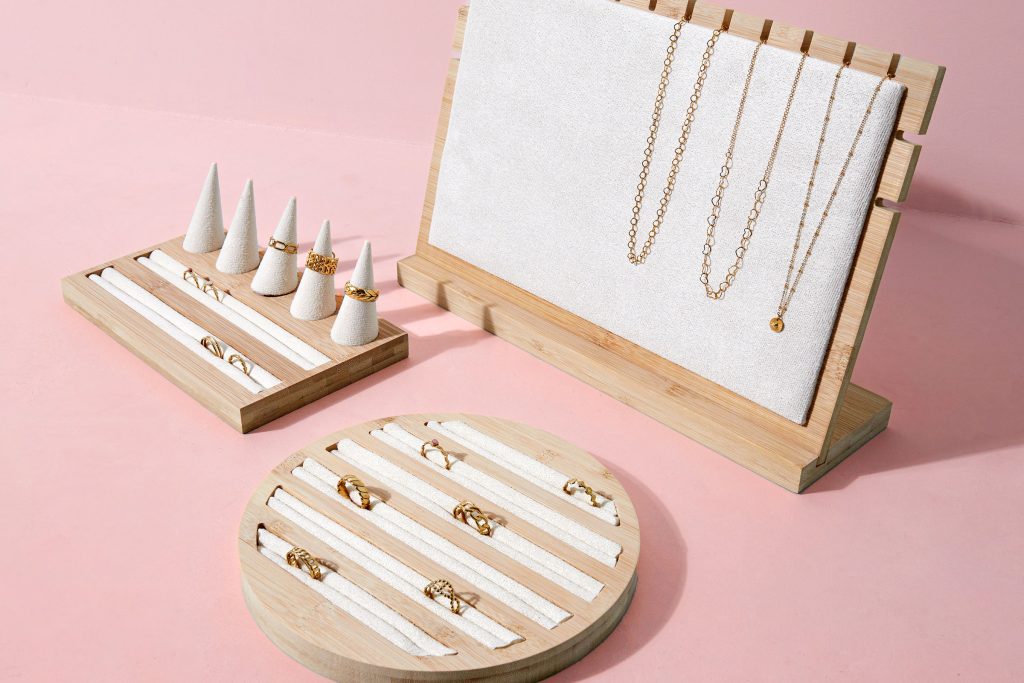
Our display range runs to around 50 items across rings, necklaces, earrings, bracelets and anklets, plus 18 jewelry trays. The same EUR 30 order value applies to all of it. Our guide to jewelry display stands covers which stand suits which piece.
Can display be customized?
The answer depends heavily on the item. Some trays, stands and busts can be customized, though feasibility, minimum and price all have to be checked with the factory case by case. Treat display in your own finish as an inquiry, and expect a job-specific answer.
What to Check Before You Order
Ask how the minimum is counted. Per design, per color or per order changes your commitment substantially. A 500-piece minimum applied across three designs is 1,500 pieces.
Ask for a visual before you ask for a sample. A digital mock-up is normally free with us, and a physical sample costs around EUR 20 and takes 3 to 7 working days. Suppliers price samples differently, so ask before you assume.
Build production time into your season. Production takes 7 to 15 working days with us, and it varies between suppliers. Shipping from the factory adds several more days. Counting back from a December launch, that puts your order in October.
Find the free shipping threshold, because that is your real planning number. A minimum order value tells you what the supplier will accept. Ours starts at EUR 100 excluding VAT for the Netherlands, Belgium, Germany and Luxembourg, and rises to EUR 200 for many other European destinations. Ask about your own country, and check whether stock shipped from outside Europe qualifies at all. Ours does not.
Ask which warehouse it ships from. European stock leaves us within 24 hours on working days, while China-warehouse orders take around three working days before dispatch.
FAQ
Q: What is the minimum order for jewelry packaging?
A: Ready-stock packaging is usually governed by an order value rather than a piece count, and ours is EUR 30 after discounts, with packaging mixable into a jewelry order. Custom production works differently: minimums depend on the product, the material and the customization, and are often counted per variant per color.
Q: How much does custom jewelry packaging cost?
A: It depends on material, size, print method and quantity, so treat any figure as indicative. As a guide, printed jewelry cards cost around EUR 0.07 a piece at 2,000 units and fabric pouches around EUR 0.20 at 5,000, with a printing and setup charge of roughly EUR 20 to EUR 30 on shorter runs.
Q: Can you get a sample before ordering custom packaging?
A: Yes. A digital mock-up is normally provided free of charge before bulk production, and a physical sample can be shipped for around EUR 20, arriving within 3 to 7 working days.
Where to Start
Work out your cost per order before you work out your branding. A minimum on a printed card and a minimum on a fabric pouch look much alike on a quotation, and commit very different amounts of money. Decide item by item rather than kit by kit.
If you would rather test packaging alongside stock than commit to a production run, create a wholesale account and order both in the same delivery.