
Table of Contents
- 1 What is nickel allergy, and how common is it?
- 2 What are the EU nickel limits for jewelry? (REACH)
- 3 What is the difference between “nickel free” and “nickel safe”?
- 4 Which jewelry materials are safest for nickel allergy?
- 5 Spotlight: Lumé, our premium stainless steel line
- 6 How can retailers make sure their jewelry is compliant? A checklist
- 7 Our commitment to you
- 8 Frequently asked questions
- 8.1 Is nickel-free jewelry legally required in the EU?
- 8.2 Is stainless steel nickel free?
- 8.3 Can I call my jewelry hypoallergenic?
- 8.4 Does gold plating make jewelry nickel safe?
- 8.5 Does 925 sterling silver contain nickel?
- 8.6 Which earrings are best for people with nickel allergy?
- 8.7 How can I test jewelry for nickel at home or in store?
- 8.8 Who is responsible if non-compliant jewelry is sold in the EU?
- 8.9 What should I do if a customer reacts to a piece?
- 9 Sources
Oct 7, 2026 · @Vivi
Quick answer: “Nickel free” has no legal definition in the EU. What EU law (REACH Annex XVII, entry 27) sets is a nickel release limit: 0.5 µg/cm²/week for jewelry in prolonged skin contact, and 0.2 µg/cm²/week for posts inserted into piercings, tested to EN 1811. Retailers should ask suppliers for accredited lab reports and label products “tested to meet EU nickel release limits” rather than “100% nickel free”.
“Is this nickel free?” is one of the most common questions a jewelry shopper asks — and one of the most often misanswered. In the EU, “nickel free” is not a legal term. What the law actually regulates is how much nickel a piece releases onto the skin, and every retailer selling jewelry in Europe is responsible for getting that right.
As Yehwang, a Dutch B2B fashion jewelry wholesaler based in Ede supplying retailers across Europe, we think retailers deserve a clear, honest explanation. This guide covers what nickel allergy is, what EU law requires, what labels like “nickel free” and “nickel safe” really mean, which materials to trust, and how to answer your customers with confidence.
What is nickel allergy, and how common is it?
Nickel allergy is a form of allergic contact dermatitis: the immune system reacts to nickel ions that dissolve from metal into sweat and pass into the skin. Typical signs are redness, itching, a rash or small blisters where the jewelry touches — earlobes, neck, wrists, fingers. Reactions usually appear 12–48 hours after contact.
Nickel is the most common cause of contact allergy in Europe. A 2017 review of EU studies found nickel allergy in 8–18% of the general population, and around 11% of women aged 18–35 even after the EU Nickel Directive took effect (Ahlström et al., Contact Dermatitis). Women are affected far more often than men, largely through earlier exposure from ear piercings and fashion jewelry.
Two facts matter for retailers:
- Once sensitised, always sensitised. The allergy does not go away; a customer who reacts once will react again to any piece that releases too much nickel.
- Piercing is the main trigger. Sensitisation most often starts with a new piercing, which is why EU law sets its strictest limit for piercing jewelry.
What are the EU nickel limits for jewelry? (REACH)
Nickel in jewelry is regulated under REACH, Annex XVII, entry 27 (ECHA restriction text), which began as the 1994 Nickel Directive (94/27/EC). The rule does not ban nickel. It caps the nickel release rate: how much nickel migrates out of the metal per square centimetre of skin-contact surface per week.
| Product type | Maximum nickel release | Test method |
| Post assemblies inserted into pierced ears or other body piercings | 0.2 µg/cm²/week | EN 1811:2023 |
| Items in direct and prolonged skin contact: earrings, necklaces, bracelets, chains, anklets, rings, watch cases and straps | 0.5 µg/cm²/week | EN 1811:2023 |
| The same items with a non-nickel coating (e.g. gold or rhodium plating) | 0.5 µg/cm²/week, maintained for at least 2 years of normal use | EN 12472:2020 wear simulation, then EN 1811:2023 |
The EU officially references EN 1811:2023 and EN 12472:2020 as the methods for demonstrating compliance (TÜV SÜD summary). Older reports citing EN 1811:2011+A1:2015 are still useful, but ask suppliers for current-version testing on new collections.

What this means in practice:
- Plating matters. A nickel-containing base metal can pass on day one but fail once the plating wears off. That is why coated items must be tested after simulated wear.
- Every skin-contact part counts — not just the main piece. Clasps, jump rings, ear-nut backs and hooks are often where products fail.
- Retailers are in the chain of responsibility. Under REACH and the EU General Product Safety Regulation (GPSR), a distributor must not place on the market products it knows or should know are non-compliant. “My supplier said so” is not a defence without documentation.
Related limits apply in the same regulation: cadmium (entry 23, max 0.01% by weight in metal jewelry parts) and lead (entry 63, max 0.05% by weight in jewelry). A responsible supplier tests for all three.
What is the difference between “nickel free” and “nickel safe”?
Because EU law regulates release, not content, the wording on a tag or product page needs care. Consumer-protection law (the Unfair Commercial Practices Directive) also means any claim must be truthful and provable.
| Label | What it usually means | Can you prove it? |
| Nickel free | No nickel intentionally added; only unavoidable traces remain. Not a legally defined term. | Only with a material composition test showing trace levels — and even then, avoid promising “0% nickel”. |
| Nickel safe / nickel compliant | Nickel release is below the REACH limit for that product type. | Yes, with an EN 1811 (and EN 12472 for plated items) report from an accredited lab. |
| Hypoallergenic | Marketing term with no legal definition; implies low risk of reaction. | Hard to prove; best avoided unless backed by test data. |
| Surgical steel | Usually 316L stainless steel — which contains nickel, but binds it tightly. | Refers to material grade, not to nickel release. |
Our recommendation: describe what you can document. “Tested to meet EU nickel release limits (REACH)” is accurate and reassuring. “100% nickel free” is a promise few fashion-jewelry products can keep.
Which jewelry materials are safest for nickel allergy?
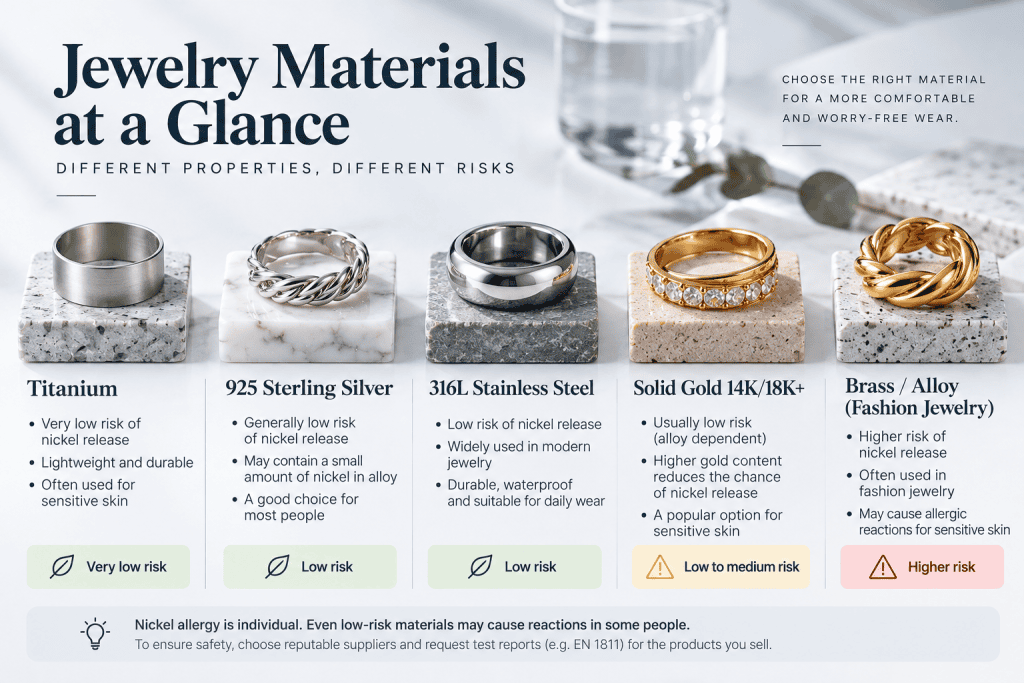
The base metal decides most of the risk. Plating can lower it, but only for as long as the plating lasts.
| Material | Contains nickel? | Typical risk for sensitive skin | Notes |
| Titanium (implant grade) | No | Very low | Best choice for new piercings. |
| 925 sterling silver | Normally no | Low | Check that plating or solder does not add nickel. |
| Solid gold 14k+ | White gold may | Low (yellow) / variable (white) | Some white gold alloys use nickel; ask for alloy details. |
| 316L stainless steel | Yes (about 10–14%) | Low | Nickel is tightly bound; usually passes the 0.5 limit. Piercing posts still need testing against 0.2. |
| Other stainless grades (e.g. 304) | Yes | Variable | Release can be higher; test results are essential. |
| Brass, copper, zinc alloy (plated) | Often in base or under-plating | Medium to high once plating wears | Common in fashion jewelry; must pass EN 12472 + EN 1811. |
| Unknown “alloy” | Unknown | Unknown | Do not sell without a test report. |
A useful shop-floor screen is the dimethylglyoxime (DMG) spot test: a swab turns pink when nickel is released. It is quick and cheap, but it is a screening tool only — it does not replace an accredited lab report.
For retailers whose customers ask for jewelry that is kind to sensitive skin, Lumé is Yehwang’s premium brand. Lumé is made from [steel grade, e.g. 316L] stainless steel, so the nickel risk is managed by the base material itself, not by a plating layer that can wear away. Its refined, editorial designs are aimed at a more mature customer who values quality materials.
What this means for your shop:
- A clear answer at the counter. You can explain the material confidently instead of relying on a vague “nickel free” claim.
- Documentation available. [Confirm before publishing: Lumé test reports, e.g. EN 1811:2023 nickel release, plus cadmium and lead, available on request.]
- Ready to sell. Lumé ships in branded packaging with a fixed recommended retail price on every tag.
How can retailers make sure their jewelry is compliant? A checklist
Before you buy
- ☐ Ask your supplier for EN 1811 nickel release reports from an accredited lab (for example SGS, Intertek, Bureau Veritas, TÜV).
- ☐ For plated items, check the report includes EN 12472 wear simulation.
- ☐ Check that piercing posts were tested against the stricter 0.2 limit.
- ☐ Ask whether cadmium and lead were tested too.
- ☐ Make sure the report matches the actual product: item number, material and plating.
In your shop and webshop
- ☐ Keep test reports on file, linked to item numbers, so you can answer authorities or customers.
- ☐ Use accurate wording: “meets EU REACH nickel release limits” rather than “100% nickel free”.
- ☐ State the base material and plating on product pages.
- ☐ Brief staff on the difference between nickel content and nickel release.
Talking to customers
- Customers with a known nickel allergy: recommend titanium, sterling silver or solid gold, especially for earrings.
- Customers who want a durable everyday piece: our Lumé stainless steel line is a strong option. Everyone else: explain that the piece is tested to EU limits, and that care (removing jewelry before showering, swimming or sport) helps plating last longer.
- If a customer reports a reaction: take it seriously, refund or exchange, note the item number and tell your supplier so the batch can be checked.
Our commitment to you
At Yehwang, we believe compliance is part of the product. If you have questions about any item in our range, contact us at info@yehwang.com and we will share the documentation we hold.
About the author: Vivi (Lihua) Wu is General Manager of Yehwang B.V., where she oversees product compliance (REACH, GPSR, EPR) and procurement for the company’s wholesale jewelry brands. Connect with her on LinkedIn.
Frequently asked questions
Is nickel-free jewelry legally required in the EU?
No. EU law limits nickel release, not nickel content. Jewelry may contain nickel as long as release stays below 0.5 µg/cm²/week, or 0.2 µg/cm²/week for posts inserted into piercings.
Is stainless steel nickel free?
No. 316L stainless steel contains roughly 10–14% nickel, but it is bound so tightly that release is usually very low. Piercing posts made of steel should still be tested against the 0.2 limit.
Can I call my jewelry hypoallergenic?
Only with care. The term has no legal definition in the EU, so back it with test data or say “tested to EU nickel release limits” instead.
Does gold plating make jewelry nickel safe?
Only temporarily if the base metal releases nickel. That is why plated items must pass a wear simulation (EN 12472) before release testing (EN 1811).
Does 925 sterling silver contain nickel?
Pure 925 silver is an alloy of silver and copper and normally contains no nickel. Problems come from nickel under-plating, solder or findings, so check the whole piece.
Which earrings are best for people with nickel allergy?
Implant-grade titanium, 925 sterling silver and solid yellow gold are the safest choices. For a new piercing, titanium is the standard recommendation.
How can I test jewelry for nickel at home or in store?
A dimethylglyoxime (DMG) spot test turns pink when nickel is released. It is a quick screen, not proof of compliance; only an accredited EN 1811 lab test is.
Who is responsible if non-compliant jewelry is sold in the EU?
Everyone in the supply chain. Importers and manufacturers must ensure compliance, and distributors, including retailers, must not sell products they know or should know are non-compliant.
What should I do if a customer reacts to a piece?
Offer a refund or exchange, record the item number and inform your supplier so the batch can be checked.
This article is for general information and does not replace legal advice. Regulations are current as of October 2026.
Sources
- ECHA: REACH Annex XVII, entry 27 (nickel), conditions of restriction
- TÜV SÜD: EC adopts EN 1811:2023 for nickel release under REACH
- Ahlström et al. (2017), Prevalence of nickel allergy in Europe following the EU Nickel Directive, Contact Dermatitis

