Table of Contents
Once a style sells well, the next step is often making it your own, with a logo on the piece, branded packaging or a design nobody else stocks. That usually means moving one step closer to production. The difficulty is that stockholding wholesalers, jewelry manufacturers producing for brands and luxury workshops all call themselves jewelry suppliers, and each expects a very different first order.
We see both sides of that step. As a wholesaler supplying European retailers from our warehouse in the Netherlands, we appear on the list below and also produce private label for customers who are ready to move beyond stock. This guide explains the four types of supplier, lists 10 companies across them, and covers how to choose one, how to work with a custom manufacturer, and how to start private label without a factory-sized order.
Which Type of Jewelry Supplier Do You Need?
What separates supplier types is the commitment each one asks of you, in quantity, in time and in how much of the design is yours. As our guide to minimum order quantities shows, the closer a supplier is to production, the larger that commitment becomes.
| Supplier type | What you get | What you commit | On this list |
| Wholesaler with ready stock | Finished pieces and fast delivery, in designs other retailers can also buy | A small order, often with a minimum set by value | Dottilove, Laval, Yehwang |
| Manufacturer working with smaller brands | Its own ranges, adapted with your logo or developed into a collection | Minimums per design or color, and a lead time of weeks | Bejew, Ellebi Catene, Klein & Schütz, Rudolf Neumann |
| Private label, OEM or contract manufacturer | Production to your specification, often under confidentiality | Minimums and prices quoted per project | Argentum, Hans Rivoir |
| Luxury workshop | High-end craftsmanship for established jewelers and fashion houses | Custom projects, quoted individually | Zanotto |
Start with the first type while you are still testing, and move down the table as your volumes and your brand grow. The costly mistake is starting at the wrong level, for example commissioning a custom collection before you know which styles sell in your shop.
Within the first type, where the stock is held also affects the price. We run both models side by side: stock in the Netherlands for fast replenishment, and our China warehouse for lower-priced sourcing on larger orders.
Jewelry Manufacturers and Wholesale Suppliers in Europe
The 10 wholesale jewelry manufacturers and suppliers below are grouped by type and listed alphabetically within each group. Each description is based on what the company states on its own website, checked in September 2026, so confirm current terms with them before you order.
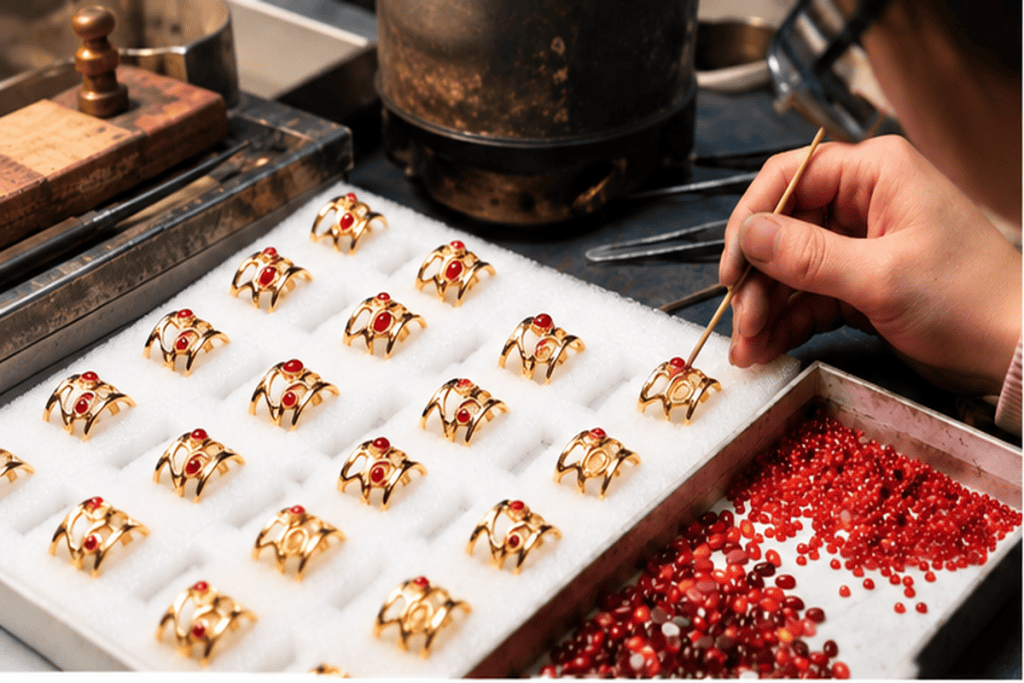
Wholesalers With Ready Stock
Dottilove, Neuss, Germany. Dottilove launched in late 2017 as an online fashion jewelry wholesaler and now supplies boutiques, webshops and outlets in more than 20 countries. The range is built on stainless steel and copper with 14K gold plating. Orders start at €50 excluding VAT, with no minimum per item, and private label and custom designs have separate minimums.
Laval, France. Founded in 1878, this family-run wholesaler supplies jewelers and retailers across the jewelry and watchmaking trade. It sells gold, gold-plated, stainless steel and sterling silver jewelry alongside packaging, display stands and findings, with no minimum order. In its own French workshop, it prints customer logos on boxes, pouches and bags in small quantities.
Yehwang, Ede, the Netherlands. Yehwang sells fashion jewelry, clothing, accessories and packaging wholesale, with a jewelry range centered on stainless steel and gold-plated stainless steel. Regular orders start at €30, and jewelry private label and packaging customization are both available, each with its own minimum.
Manufacturers That Work With Smaller Brands
Bejew, Arezzo, Italy. Bejew makes jewelry in 925 silver, brass and bronze from recycled metals. It serves brands, boutiques, concept stores and fashion bloggers, with very low minimums. Retailers can add their own brand to unbranded catalog pieces with a tag, a pendant or laser engraving, or develop a full collection with the in-house design team.
Ellebi Catene, Monte San Savino, Italy. This chain specialist produces sterling silver chains and silver jewelry for manufacturers, wholesalers and importers. Its chains are available with rhodium, yellow gold, rose gold or ruthenium plating. The company keeps ready stock and also makes pieces to a customer’s request.
Klein & Schütz, near Idar-Oberstein, Germany. Since 1976, this family business has produced stainless steel, titanium and silver jewelry for wholesalers, mail-order companies and established labels. It develops exclusive collections under the customer’s brand, handles labeling and packaging, and supplies chains, clasps and components.
Rudolf Neumann, Kaufbeuren, Germany. Now in its third generation, the company has made clasps and fashion jewelry for international clients since 1947. It handles development, tooling, casting in white and precious metals, and plating in-house, and produces custom private label collections for selected customers.
Private Label, OEM and Luxury Manufacturers
Argentum, near Płock, Poland. Argentum was founded in 1920 and works in 925 silver, 585 and 750 gold and titanium, with rhodium and gold plating. Pieces are polished and checked by hand, and it takes on private label, OEM and ODM projects under confidentiality, sets minimums per project and accepts small trial runs. A separate wholesale arm supplies shops and webshops.
Hans Rivoir, Pforzheim, Germany. Hans Rivoir has worked with major customers and retailers since the 1950s, producing luxury and OEM jewelry for jewelers and brands in Europe and worldwide. It has supplied online retailers in large quantities for more than 10 years.
Zanotto, Valenza, Italy. With 60 years of tradition in top-of-the-range jewelry, Zanotto now positions itself as a luxury factory for international brands. It makes custom pieces for exclusive jewelers and fashion labels, with fine hand finishing as its distinguishing feature.
How to Choose a Jewelry Manufacturer
Start from your own range. A supplier working in 750 gold and one working in plated brass serve different price points, so choose by what your customers pay.
Ask how the minimum is counted. Some suppliers count per product and color, others per project, others by order value, and each method commits you to a different quantity. Ours, for instance, is a €30 order value, and products from our Netherlands and China warehouses can be mixed to reach it.
Check who the supplier normally serves. A factory selling to wholesalers and importers works to different volumes than one courting boutiques, and you will notice the difference in lead times, pricing and minimums.
Ask for samples and references. You learn more about finish and plating from a physical sample than from any photograph, and a customer of similar size can tell you how the supplier handles orders like yours. It also takes only a few minutes to confirm in the national business register that the company is still trading.
Whichever supplier you choose, ask for material composition and plating details on a small order as much as on a large one, because the business selling the piece to consumers is responsible for it.
How to Work With a Custom Jewelry Manufacturer
Write your first inquiry as a brief, and you will get a more useful answer. Include a design, sketch or reference photos, the material and finish, the quantity per design you expect to order, your target price and the date you need the goods in your shop. Stating a target price saves time on both sides, since the supplier can tell you at once whether the piece fits your budget or what would have to change.
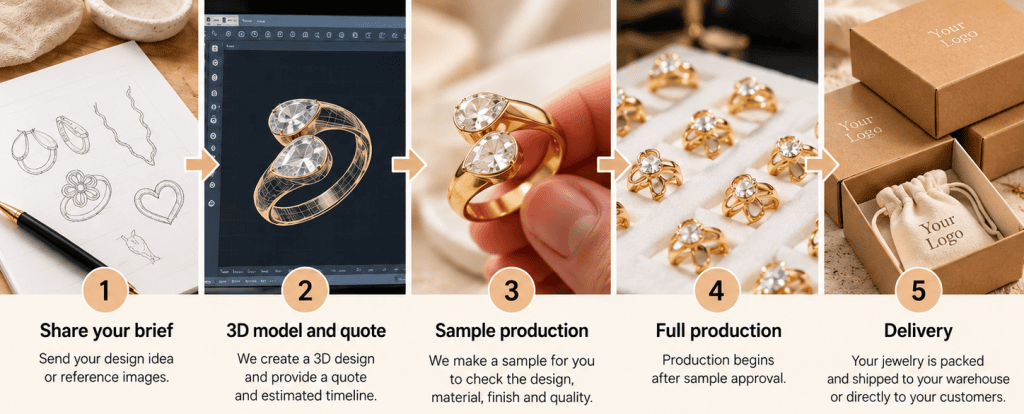
Most custom projects follow the same sequence: a 3D model or technical drawing with a quote, a physical sample, and production. In our own private label projects, production starts only once the customer has approved the sample, and it is worth asking any supplier to work the same way.
Approve the 3D render before any metal is cast, and get the minimum and the lead time in writing. If the minimum is too high for a first order, ask whether a trial run is possible. Some manufacturers state openly that they accept one.
Then plan backward from your launch date. Add up the sample stage, production and delivery, and leave room for one round of corrections, because the sample often needs adjusting. A holiday collection, for example, needs a brief well before summer.
Starting Private Label Without a Factory-Sized Order
Private label can begin long before you have a design of your own. The first step is your logo on pieces a supplier already makes, and several companies on the list above offer private label on their existing designs. For relatively simple designs, our own jewelry private label typically starts at around 120 to 150 pieces per design, while more complex designs can need different minimums. Production begins only after you approve the sample.
Branded packaging is the next step, and the jewelry stays exactly as it is. Customers still see a piece differently in a branded box or pouch. With us, packaging customization runs separately from jewelry private label and has its own minimums, and our guide to jewelry packaging for small business covers what that commits you to.
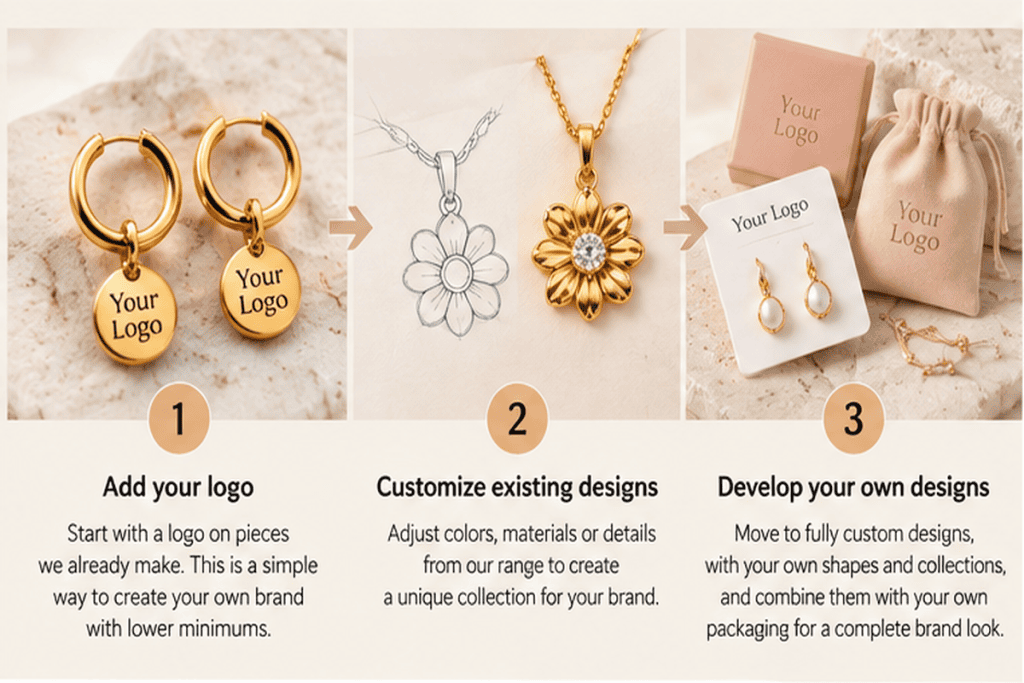
Your own design comes last, because this is where minimums rise. Move to this step once a style has a proven sell-through rate in your shop. For a wider selection of suppliers built around this model, see our overview of private label jewelry manufacturers.
FAQ
Q: What is the difference between a jewelry wholesaler and a jewelry manufacturer?
A: A wholesaler sells finished pieces from stock, usually with low minimums and fast delivery. A manufacturer produces the pieces, either as its own range or to a customer’s design, and asks for a larger commitment in exchange for control over design and branding. Some companies do both.
Q: Can a small boutique work directly with a jewelry manufacturer?
A: Yes, if it picks the right one. Some manufacturers aim at smaller brands and state low minimums or accept trial runs, while others work mainly for established labels. A logo on pieces the manufacturer already makes keeps the initial commitment small. If you sell online, dropshipping is another low-risk way in: our dropshipping service has no minimum, so you can test a style before buying stock.
Q: How long does custom jewelry production take?
A: It depends on the supplier and the piece. Stock is the fast option: orders from our Netherlands warehouse typically reach the Netherlands, Belgium and Germany in one to three working days. Custom production takes longer, because a model, a sample and your approval all come before production starts. Ask for the timeline in writing before you commit.
Finding Your Starting Point
The right manufacturer depends on the stage your shop is at more than on any ranking. Treat the list as a starting point: contact two or three suppliers of the type that matches your stage, send each the same brief, and compare their answers on minimums, lead times and price.
If you want to test styles before committing to production, create a wholesale account with us and start with an order sized to your shop. When a style proves itself, the next step can be your own logo on it.